
To many people this may seem like a bizarre title. I mean, how can video games be powered by steam like a Victorian engine? After all, games are played on electronic devices like computers and PlayStations, right? Well, what I mean by this is not water vapour per say, but rather an online video game distribution platform created by Valve in 2003 (Steam, 2019).

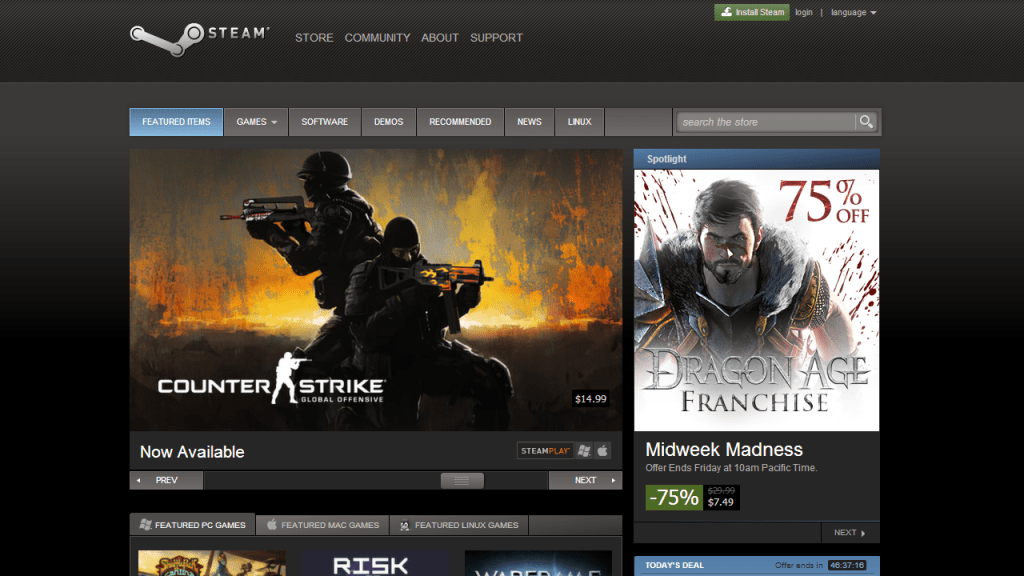
To those unaware of Valves digital platform, Steam is a software and store where consumers can purchase and download the latest video games to their PC directly, all-the-while being able to receive updates and engage with a centralised global community. Today, the site and the software has become an icon in the gaming community, and now boasts 14,278,701 concurrent users daily, with the annual revenue of the site reaching $4.3 billion in 2017 (Steam Statistics, 2019; Statista, 2019).
Initially, the site began its life as a way for Valve to patch and update their own games, as well as to prevent cheating within their products such as Counter-Strike (Sayer. and Wilde, 2018, para. 2). During this time, Steam was a closed piece of local software, and was not directly acting as a marketplace. However, this would change by 2006, as Steam would begin to allow third-parties to distribute and sell their games on Valve’s platform. With this, Steam would additionally begin to charge developers for the selling of their product on the site. Through this, Steam would soon become the giant we see today, through its accessible digital business model.
Examining this further, undoubtedly, following the ideas presented by F. Li, Steam can be portrayed as very transformational to the gaming industry (Li, 2017, p. 7). The concept of a centralised online marketplace, where consumers could directly download video games from one platform was relatively revolutionary at the time (2006-7). As a result, game developers, and subsequently consumers, began to flock towards the site leading to the rapid evolution of the software. Through its unique differentiation, Steam was able to centralise the online gaming market.
Nevertheless, in hindsight, Steam was by no means completely innovative, as there were already centralised video game distributors in the form of physical stores, such as Game and GameStop. Consequently, following the ideas proposed by Li’, Steam is a part of ‘Automation’, as Valve used their developed software to create an online store, where consumers could purchase games within the comfort of their own homes (Li, 2017, p. 7). This in turn could also be regarded as a part of ‘McDonaldisation’ through the concept of convenience, as by using Steam consumers can purchase games from their PC or even their phone (Ritzer, 2011, p. 16).
Following this, Steam is also an extension of a traditional marketplace for video games, as Valve created and popularised the idea of virtual products. In this case, Valve created additional cosmetics for games referred to as skins, where consumers could pay real money for virtual products, such as a different character or weapon cosmetics. Even today, many players pay huge amounts of money for these ‘non-existent’ items, with some skins selling for over $1000 (Knoop, 2017, para. 2). This notion of skins has now become a staple of the gaming industry since Valve’s creation of this model. This in itself has added to the success of Steam’s business model, as Valve managed, and is still managing, to sell virtual products for an incredibly high price, for an almost non-existent production cost.
With this all-in mind, Steam certainly paved the way for a new way to purchase, download, and engage with video games. However, today it faces the growth a new online marketplaces and game launchers. Although initially, due to the size of Valve, the threat of new entrants was incredibly low, as the gaming industry evolved, companies were able to finance and develop their own launchers and sites. This of course is in an attempt to surpass the charges that Steam enforces on games that are distributed within their platform. Numerous examples of this can be seen in the industry such as Origin and Uplay, as well as separate online stores for consoles.
Whilst to begin with this may have been of little concern to Valve as they still hold a majority of the market, recently, there have been some major companies and titles leaving their platform for a cheaper alternative. One of the most noteworthy examples of this was Deep Silver’s abandoning of Steam after using the platform for several years. In this case, following the much anticipated ‘Metro Exodus’, which was available to pre-order on Steam, Deep Silver decided to move their game exclusively to the epic Launcher a few weeks before its release, thus ending their contract with Valve (Knezevic, 2019, para. 1). Such a large and popular title moving away from Steam was certainly a statement.
In such a light, whilst Valve’s business model may have been a pioneer in the gaming industry, its future is perhaps clouded, as the marketplace is becoming separated through the creation of new launchers and sites. As such, one can question whether it is time for the video game industry to move away from Steam power?
Bibliography
Knezevic, K. (2019). Metro Exodus Leaving Steam for Epic Games Store Seems Controversial Even Inside THQ. Retrieved 28th February, 2019, from https://www.gamespot.com/articles/metro-exodus-leaving-steam-for-epic-games-store-se/1100-6464698/.
Knoop, J. (2017). The Most Expensive CS:GO Skins of 2017. Retrieved 28th February, 2019, from https://www.pcgamer.com/csgo-skins-most-expensive/.
Li, F. (2017). The digital transformation of business models in the creative industries: A holistic framework and emerging trends. Technovation. Retrieved 28th February, 2019, from https://www.sciencedirect.com/science/article/pii/S0166497217300536?via%3Dihub.
Origin. (2019). Homepage. Retrieved 28th February, 2019, from https://www.origin.com/gbr/en-us/store,
Ritzer, G. (2011). The McDonaldization of Society. Sixth ed. London.
Sayer, M., and Wilde, T. (2018). The 15-year Evolution of Steam. Retrieved 28th February, 2019, from https://www.pcgamer.com/steam-versions/.
Statista. (2019). Revenue Generated by Game Sales on Steam from 2014 to 2017. Retrieved 28th February, 2019, from https://www.statista.com/statistics/547025/steam-game-sales-revenue/.
Steam Statistics. (2019). Steam and Game Stats. Retrieved 28th February, 2019, from https://store.steampowered.com/stats/.
Steam. (2019). Homepage. Retrieved 28th February, 2019, from https://store.steampowered.com/,
Uplay. (2019). Homepage. Retrieved 28th February, 2019, from https://uplay.ubisoft.com/en-GB.
 Digtial Business Models
As a gamer, I cannot help but comment on your insightful post. I always find Steam a strange name for a gaming platform but hey it works. I like the digital model being centralised because I remember how I had to buy all the game consoles to play exclusive games e.g. Nintendo. Plus, you can discover games released from indie developers that I would have never heard of in physical store. Another thing I like is that it integrates review sites and forum into their business model to allow gamers to communicate and share content such as customisation files, videos and tutorials etc. I also like how you can get mods for games. My issue is the cost of games on the platform and I think Steam exploit this by offering limited time discount sales just like how high street stores boost sales. At the moment I don’t think there is a worthy contender that can compete against Valve, because it has such a huge selection of games.
LikeLike
Thank you for your sharing. I have to say that steam has dominated the digital game market for many years, and I was one of the users. As a steam user, I use steam because there are so many interesting indie games on steam and often discount. Steam is a great digital game platform for gamers since it sells a lot of quality games from around the world. For developers, there is no need to bear a high store and logistics costs, while reducing the possibility of second-hand games. However, as you say, big companies such as Ubisoft and EA have left now because of Steam’s high gross split.
In response to your last question, I would say that there are two types of game companies/developers that I don’t think will leave Steam for now, while developers are likely to move to other platforms in the future. The first one is games with low investment. For example, indie games will be released on steam. Because Steam still can bring them certain visibility, which is an opportunity for developers. Second, companies with low game production capacity, such as studios which only produce one game a year, they have no need to create or maintain their own digital game platforms.
LikeLike