A course like this has certainly been an experience for me. Throughout my academic career I have never really had the opportunity to directly engage with my colleagues and their work, as more often than not, at this level of academia, we only read people’s work if it was deemed publishable. This of course is due to the fact that for my undergrad I did a History BA, so it was a breath of fresh air when I was able to read someone else’s work, mainly as it provided me with new insights as well as a way for me to develop my critical skills.
Poorly edited in the sun, but hey it has to be done!
As aforementioned, when reading other people’s blogs, I was
able to experience a perspective I would never have thought of on my own.
Briefly looking at this, some of the most interesting reads to me were those
concerning digital business models that I personally use. A key example of this
would be Emily’s piece on Netflix (Holding, 2019). As a streaming service that
I use regularly, it was interesting to see the how Emily’s examination of its
business model made me question the social perceptions of the brand and where
it stands today. In this sense, her work made me think about my own views of
the brand, which were prompted by her perceptions.
Tied to this, not only did I gain new insights from my colleagues,
but I also refined and developed the way in which I provided feedback. Whilst
my first initial comments were limited and perhaps basic, during the course I
developed the way in which I provided feedback. In this case I began to lengthen
my responses, as I was able to not only tell my colleagues about the positives
of their work, but also questions and perspectives that I had. This then could
then develop into further conversation which I believe is of incredible value
to the working world. Following this, in the future I would like to take this
further and begin more to use Gibbs’ Reflective Cycle (Mindtools, 2019).
Conclusively, I believe that this course has taught me some incredibly
valuable skills that will remain with me throughout my career. As I am now
starting my role as a sales and marketing executive at Primal Europe, I feel
that these skills will be of inconceivable value, and something that I must use
in my every day.
To many people this may seem like a bizarre title. I mean,
how can video games be powered by steam like a Victorian engine? After all,
games are played on electronic devices like computers and PlayStations, right?
Well, what I mean by this is not water vapour per say, but rather an online
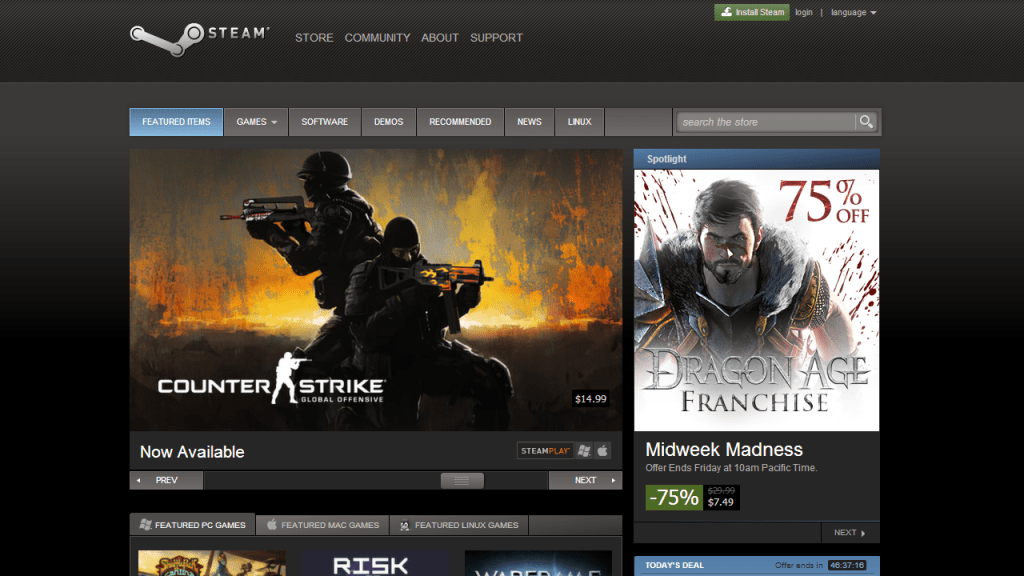
video game distribution platform created by Valve in 2003 (Steam, 2019).
To those unaware of Valves digital platform, Steam is a software
and store where consumers can purchase and download the latest video games to
their PC directly, all-the-while being able to receive updates and engage with
a centralised global community. Today, the site and the software has become an
icon in the gaming community, and now boasts 14,278,701 concurrent users daily,
with the annual revenue of the site reaching $4.3 billion in 2017 (Steam
Statistics, 2019; Statista, 2019).
Initially, the site began its life as a way for Valve to
patch and update their own games, as well as to prevent cheating within their products
such as Counter-Strike (Sayer. and Wilde, 2018, para. 2). During this time,
Steam was a closed piece of local software, and was not directly acting as a
marketplace. However, this would change by 2006, as Steam would begin to allow
third-parties to distribute and sell their games on Valve’s platform. With this,
Steam would additionally begin to charge developers for the selling of their
product on the site. Through this, Steam would soon become the giant we see
today, through its accessible digital business model.
Examining this further, undoubtedly, following the ideas
presented by F. Li, Steam can be portrayed as very transformational to the
gaming industry (Li, 2017, p. 7). The concept of a centralised online marketplace,
where consumers could directly download video games from one platform was
relatively revolutionary at the time (2006-7). As a result, game developers,
and subsequently consumers, began to flock towards the site leading to the rapid
evolution of the software. Through its unique differentiation, Steam was able
to centralise the online gaming market.
Nevertheless, in hindsight, Steam was by no means completely
innovative, as there were already centralised video game distributors in the form
of physical stores, such as Game and GameStop. Consequently, following the
ideas proposed by Li’, Steam is a part of ‘Automation’, as Valve used their
developed software to create an online store, where consumers could purchase
games within the comfort of their own homes (Li, 2017, p. 7). This in turn
could also be regarded as a part of ‘McDonaldisation’ through the concept of
convenience, as by using Steam consumers can purchase games from their PC or
even their phone (Ritzer, 2011, p. 16).
Following this, Steam is also an extension of a traditional marketplace
for video games, as Valve created and popularised the idea of virtual products.
In this case, Valve created additional cosmetics for games referred to as
skins, where consumers could pay real money for virtual products, such as a different
character or weapon cosmetics. Even today, many players pay huge amounts of money
for these ‘non-existent’ items, with some skins selling for over $1000 (Knoop,
2017, para. 2). This notion of skins has now become a staple of the gaming industry
since Valve’s creation of this model. This in itself has added to the success
of Steam’s business model, as Valve managed, and is still managing, to sell
virtual products for an incredibly high price, for an almost non-existent
production cost.
With this all-in mind, Steam certainly paved the way for a new
way to purchase, download, and engage with video games. However, today it faces
the growth a new online marketplaces and game launchers. Although initially,
due to the size of Valve, the threat of new entrants was incredibly low, as the
gaming industry evolved, companies were able to finance and develop their own launchers
and sites. This of course is in an attempt to surpass the charges that Steam enforces
on games that are distributed within their platform. Numerous examples of this
can be seen in the industry such as Origin and Uplay, as well as separate online
stores for consoles.
Whilst to begin with this may have been of little concern to
Valve as they still hold a majority of the market, recently, there have been
some major companies and titles leaving their platform for a cheaper
alternative. One of the most noteworthy examples of this was Deep Silver’s
abandoning of Steam after using the platform for several years. In this case, following
the much anticipated ‘Metro Exodus’, which was available to pre-order on Steam,
Deep Silver decided to move their game exclusively to the epic Launcher a few
weeks before its release, thus ending their contract with Valve (Knezevic, 2019,
para. 1). Such a large and popular title moving away from Steam was certainly a
statement.
In such a light, whilst Valve’s business model may have been
a pioneer in the gaming industry, its future is perhaps clouded, as the marketplace
is becoming separated through the creation of new launchers and sites. As such,
one can question whether it is time for the video game industry to move away
from Steam power?
Every day, without fail, my Grandfather will walk to the village shop, whether rain or shine, to fetch a morning newspaper. Perhaps this is simply an excuse to get himself up in the morning, or it may because he wants to be alone with his thoughts, even for a couple of minutes. Yet, even if this is the case, he still hands in his subscription voucher for The Times newspaper, and returns home, reading the ‘news’ over a morning cup of tea.
To a modern viewer, this may seem like a timely practice, as
why would you buy a newspaper when you can access everything from your phone?
Certainly, this is a generational matter, and one that is embedded in the older
routines of baby boomers, where newspapers were one of the most important ways
in receiving the ‘news’. Today, on the other hand, consumers can see what’s
going on in the world through numerous channels and outlets, consequently
making the market incredibly diverse. With this in mind, I want to briefly examine
how The Times, the newspaper my
grandfather reads, operates both physically and digitally.
Principally, The Times both prints papers, as well as hosts an active online website (The Times, 2019). This is in an attempt to keep with the moving technological times, as well as to accommodate for those who still prefer the traditional feel of a newspaper. Of course, they are not the only periodical that has done this, yet The Times has stuck with their niche subscription business model. In this case, even though you are not buying a physical paper, consumers still have to pay £26 per month, or £6 a week, to access the online articles (The Times, 2019, Subscription). Unlike other newspapers, The Times uses a subscription model in order to fund the website without having to monetise their website, in order to create a professional atmosphere. On the other hand, other newspaper outlets such as The Guardian are free to access, in order to do this, their website is home to numerous advertisements, which is a strategy that is working but focuses around a different demographic (The Guardian, 2019).
Following this, there are evidently many benefits for The Times moving to an online platform. Firstly, the internet is almost universally accessible, which allows the newspaper to be seen by a much larger audience. This is undoubtedly a very generalised statement, however even looking at the UK, in 2017 nearly 95% of citizens owned a smartphone (Statista, 2019, para. 1). Tied to this, unlike printed papers, online articles published by The Times can be uploaded instantly and edited on the fly. This allows for a greater number of journalists to contribute due to the flexible nature of this platform as well as more articles to be published.
Yet, perhaps The Times moving online is a double-edged sword. What I mean by this is that whilst traditional newspapers face off against a limited number of competitors, as there is a low level of new entrants threat, the online market is free and open, as ‘news’ outlets must face off against countless websites all aiming to grab the attention of the consumer. From websites such as the BBC to other casual outlets like BuzzFeed News, it’s often difficult to differentiate and attract an audience amongst an endless sea of news (BBC, 2019; BuzzFeed News, 2019). In this case, the paywall that The Times resides behind may deter consumers away from their website, as such, the question begs whether in this age the articles should be free. An opportunity is clearly there, however one that may have a larger impact on the brands equity and positioning.
Regardless, The Times continues to print its newspapers that still appear nationwide, mainly for those who still prefer the seemingly traditional feel of a newspaper. Looking at this in general, newspapers have been a part of society for hundreds of years, and they a key part of the ‘news’ cycle, with the birth of print deriving in the 1450s (Temple, 2008, p. 4). Whilst printing papers may be costlier, and it does take more consideration when editing and creating the publication, this ultimately is a practice that The Times, and other newspapers, have perfected over their years of existence. As such, whilst there are still those wanting to have a newspaper in their hands, it would be foolish to ignore this market.
However, whilst it is important for The Times to retain their audience who likes traditional publications, ultimately the sales of newspapers are decreasing. Even in 2015, there was a decrease in newspaper sales by 7.6%, and the reasons for this are of course varying (Jackson, 2015, para. 1). Partly this is due to changing consumer habits, however it is also potentially fiscal, as it is far more cost efficient to maintain a website than to print a paper every day. In addition, with the world aiming to become paperless, newspapers are incredibly wasteful and maybe deemed unnecessary in a world full of smart devices (Bennett, 2017, para. 2).
With all this in mind, it is clear that The Times is using its online platform to expand its viewership in a digital age, much like other tabloids, however the question begs, how long until my grandfather no longer walks to the shop and simply picks up his iPad?
Since I was eighteen I was always working behind a bar, pouring pints, making cocktails, and making sure people have a good time (and one they hopefully could remember). Throughout this part-time career my work tended to revolve around face-to-face transactions with a customer. A little small talk, here, the pouring of a drink over there; yet, this changed in 2017. At the time I was working in Falmouth Wetherspoon’s and that year they introduce their ‘order and pay’ app (Griffin, 2017, para. 2). The worry for me was that such an app, as an extension of McDonaldization, would kill the relationship between the barman and customer (Ritzer, 2011, sixth ed.).
Initially the app didn’t seem to do much, as the people still came to the bar, especially our older clientele. However, as the app became more popular, more and more people would order their food and drinks from their tables. In this case, we would simply read a number off a screen and the order, where we would make it, and let one of the waiter’s take it over. Suddenly I felt alone, in a job which historically thrived off conversation. It was not long before I left.
Looking at this from my current perspective, it is evident that this was a system designed to increase the efficiency of orders and the swiftness of service. No longer did consumers have to stand up and wait at the bar, as they could now order their drinks from the comfort of their own phone. Moreover, all payments are made online, and as such day-to-day financial checks can be done at a much faster rate. In this sense, I wouldn’t be surprised if Wetherspoon’s in the future went completely cashless, as contactless transactions remove the time-consuming element of managers cashing up.
In addition, when reflecting upon this, following the ideas of Douglas Adams, and his statement concerning new technology, it is evident that I was very reluctant to accept these new social changes that stemmed from a new app (Adams, 2003, p. 95). However, it has proved successful and is still used today. My question then is how long till such technologies kills the barman?



 Digtial Business Models